
BY NATHAN COYLE / ON 22 SEPTEMBER, 2025
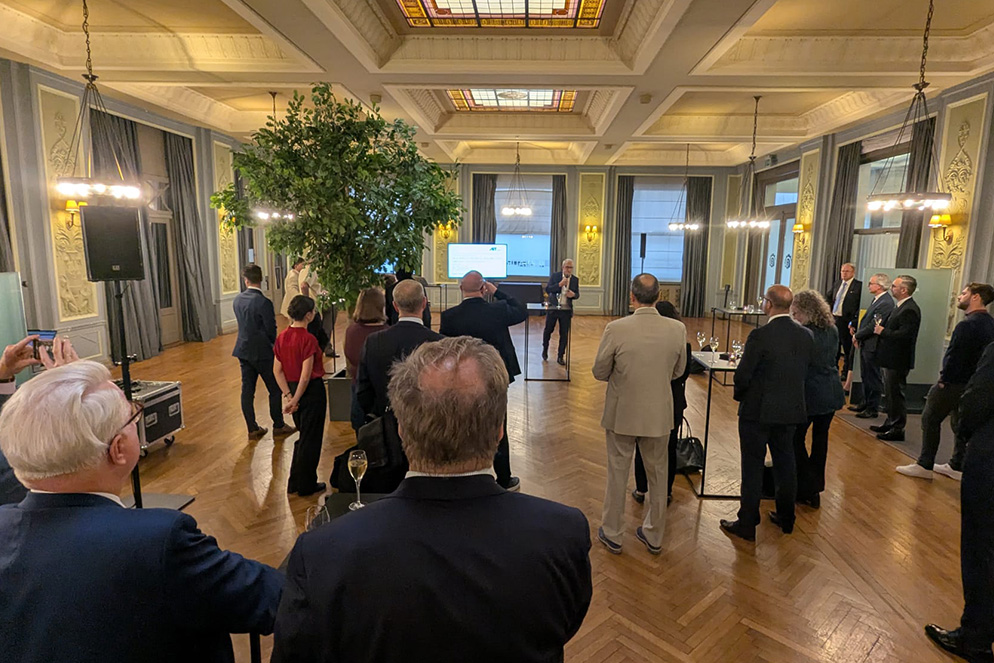
On Monday 8 September, the PeaceTech Alliance marked its European launch in Brussels with a policy dialogue at the Résidence Palace, co-organised with the Permanent Representation of Austria to the EU. Following our official launch at IDSF25 in Austria earlier this year, this gathering was an important step in connecting Europe’s foreign policy community with the emerging practice of PeaceTech.
Brussels is where Europe’s debates on digital governance, diplomacy, and security converge. Bringing the Alliance here was about ensuring that conversations on ethical, human-centred PeaceTech are not happening at the margins, but at the heart of policy.
The evening began with remarks from Ambassador Philipp Agathonos, who underlined Europe’s responsibility to shape technology that serves diplomacy and stability. Nathan Coyle (Austrian Centre for Peace / AIT) followed with reflections on why PeaceTech matters now: the need to embed ethical design principles, to recognise both the opportunities and the risks, and to ensure Europe positions itself as a leader in responsible innovation. He also introduced the PeaceTech Alliance itself — a collaborative, not-for-profit initiative uniting institutions across Austria and Europe.
The keynote address by Dr Helmut Leopold (AIT / Gaia-X Hub Austria) focused on “Dataspaces for Peace—Building Trust Through Digital Sovereignty.” He argued that Europe’s model of federated dataspaces provides a pathway to balance local agency, security, and innovation. In peacebuilding, where trust is everything, such models can ensure that sensitive data supports dialogue without being misused or centralised in ways that undermine sovereignty.
The panel conversation, moderated by Philippe Reinisch (SilkRoad 4.0), brought together Lena Slachmuijlder (Council for Tech and Social Cohesion), Jean Baptiste Valmary (EEAS), and Lucile Bardin (Martti Ahtisaari Peace Foundation).
Phillip also raised data from a recent survey conducted with over 170 peacebuilders working on the front line. While 95% of respondents saw technology as a real tool in peacebuilding, only 2.4% believed current technologies understand the real needs of people living and working in conflict zones.
The discussion centred on two themes:
Understanding needs. The speakers highlighted the persistent gap between PeaceTech designed in European capitals and the lived experiences of peacebuilders in conflict-affected contexts. Closing this gap, they agreed, requires not just consultation but co-creation, with local actors actively shaping what tools are built and how they should work.
Accessibility and usability. Advanced digital platforms risk excluding those with limited connectivity. The panel stressed that if PeaceTech is to have real impact, it must function in low-bandwidth, mobile-first environments, and be adaptable across languages and contexts. As one participant noted, technology for peace must be judged by its practicality in fragile states, not its technical sophistication alone.
The Brussels launch reinforced the case for a European role in shaping PeaceTech that is inclusive, ethical, and aligned with democratic values. It also showed the appetite among diplomats, researchers, and practitioners to work together on this agenda.
For the PeaceTech Alliance, this is only the start. We will continue building a network that connects practice with policy, ensuring that PeaceTech remains a tool for peace, not just for innovation’s sake.