
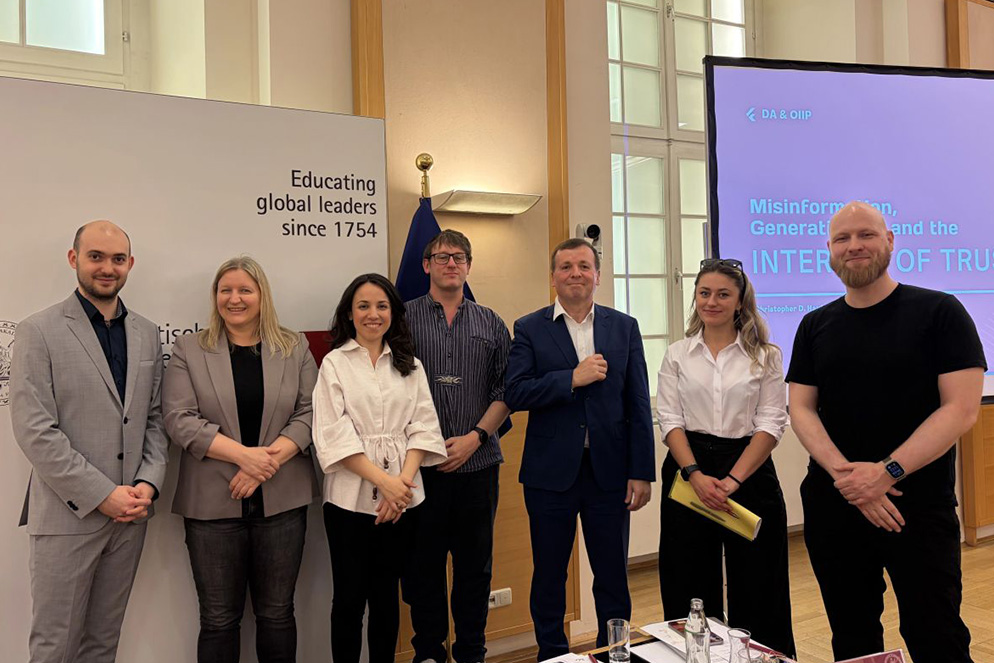
Pictured: Panel participants following the public roundtable at Diplomatische Akademie Wien on misinformation, generative AI, and digital trust.
BY Nathan Coyle / ON 17 MAY, 2026
On 5 May, the PeaceTech Alliance took part in a public roundtable at the Diplomatische Akademie Wien exploring misinformation, generative AI, and the growing discussion around the idea of an “Internet of Trust.”
The event brought together experts from across diplomacy, research, technology, and policy to reflect on how digital information ecosystems are changing, and what this means for trust, democracy, and society more broadly.
During the discussion, Nathan Coyle, Senior Expert in PeaceTech at the Austrian Institute of Technology (AIT), reflected on how generative AI is reshaping the PeaceTech space, which has traditionally framed technology as a tool for conflict prevention, dialogue, and peacebuilding. The discussion explored whether generative AI has changed that promise, where opportunities still exist for positive peacebuilding outcomes, and how the erosion of a shared factual baseline increasingly affects diplomacy and international relations.
A key theme throughout the conversation was the growing challenge of trust within digital environments increasingly populated by AI-generated content, recommendation systems, bots, and synthetic media. The discussion examined how misinformation, manipulated narratives, and rapidly evolving AI systems are complicating how individuals, institutions, and societies interpret information online.
The PeaceTech Alliance also highlighted the importance of ensuring that digital systems are designed around the realities of the communities they are intended to serve. As AI systems become more influential globally, questions around data sovereignty, local participation, and inclusive governance are becoming increasingly important, particularly in fragile or conflict-affected contexts.
Across the discussion, participants reflected on the need to move beyond technology-first approaches and instead focus on strengthening digital literacy, community resilience, and accountable forms of digital governance. The conversation reinforced that trust cannot simply be engineered into systems after the fact, but must be built through inclusive participation and transparent design from the outset.
The panel featured Ceren Çetinkaya (Central European University and Austrian Institute for International Affairs), Cornelius Granig (Sigmund Freud Private University Vienna), Julia Neidhardt (TU Wien and UNESCO Co-Chair on Digital Humanism), Alexander Czech, and Nathan Coyle (AIT). The discussion was chaired by Liliia Sablina from the Vienna School of International Studies.
A big thank you to the Diplomatische Akademie Wien and the Österreichisches Institut für Internationale Politik for hosting the discussion and creating space for such an important conversation.